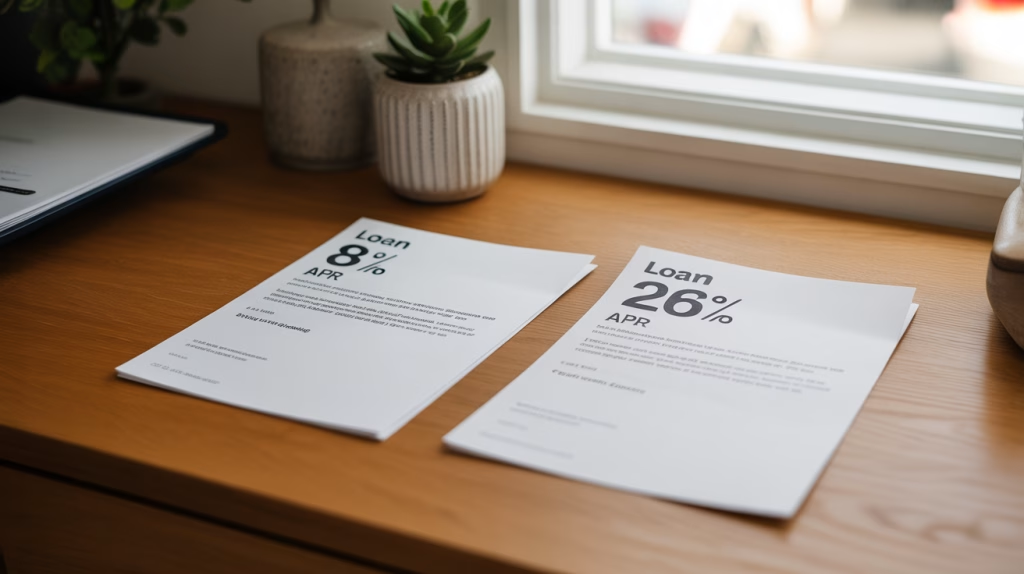
The jump from a 760 to an 850 credit score costs years of effort and often yields zero improvement on your loan rate. Most lenders price personal loans at the same APR tier for any score above a certain threshold — typically 720 or 740. Below that threshold, the rate curve steepens sharply. This guide explains where the real cutoff points are, why “perfect” credit is mathematically irrelevant for borrowing, and what to focus on instead.
What are the credit score ranges for FICO and VantageScore?
FICO and VantageScore both use a 300–850 scale, but their category labels differ slightly. FICO 8 remains the most commonly used model for personal loan decisions. Here is how the ranges break down, including typical personal loan APRs as of 2026:
| Personal loan | Larger planned expenses, consolidation, or emergency costs | Fixed monthly installments | Usually unsecured |
| Installment loan | Predictable repayment over several months | Scheduled installment payments | Often unsecured |
| Payday loan | Short-term cash needs | Usually due by next payday | Unsecured |
APRs shown are illustrative ranges based on published lender data. Actual rates depend on income, debt-to-income ratio, loan amount, and lender criteria — not the score alone. Borrowers in the 300–579 tier are not automatically disqualified from installment lending; the guide on what lenders look at beyond FICO for a 450 credit score explains how alternative underwriting works at that level.
What is a good credit score for personal loan approval?
For most unsecured personal lenders, a score of 640 opens the majority of options, 700 qualifies you for competitive rate tiers, and above 740, marginal rate improvements become negligible. The practical approval landscape in 2026:
What each score threshold unlocks
- 580: Near-prime FinTech lenders (Avant, OneMain) — rates may reach 35.99% APR, limited amounts
- 620: Broader marketplace lenders; some credit unions with existing membership relationships
- 660: Most mainstream online lenders (SoFi, LendingClub lower range)
- 700: Competitive rate tier at most lenders; favorable debt-to-income assumptions
- 720: Best published APR tiers at Wells Fargo, Discover, and major bank personal loan products
- 740+: Incremental rate gains — often less than $5 per month difference on a $5,000 loan versus a 720 score
Why does a score above 740 rarely improve your loan rate further?
Lenders price risk in bands, not on a continuous curve. A lender may have four internal rate tiers — exceptional (720+), good (680–719), fair (620–679), challenged (below 620) — and every borrower within a band receives the same rate. There is no listed discount for a 790 score versus a 730 score when both fall in the top tier.
This is reflected in most major lenders’ rate disclosures: the lowest published APR is available to “qualified borrowers” with a minimum score typically between 700 and 730. Anything above that floor does not unlock a separate tier.
Which credit score do lenders actually use?
Most personal loan lenders use FICO Score 8 as their primary model, though some use FICO 9, FICO 10T, or VantageScore 4.0. There is no universal standard. According to Fair Isaac Corporation, FICO 8 remains the most widely deployed version for consumer credit decisions as of 2026.
Experian, TransUnion, and Equifax each calculate their own version of your FICO score using the same model but with their own data. Your scores across bureaus can vary by 20–50 points, and lenders often pull from one specific bureau or take the middle score of all three.
| Personal loan | Larger planned expenses, consolidation, or emergency costs | Fixed monthly installments | Usually unsecured |
| Installment loan | Predictable repayment over several months | Scheduled installment payments | Often unsecured |
| Payday loan | Short-term cash needs | Usually due by next payday | Unsecured |
This is why the score you see on Credit Karma (VantageScore 3.0 from TransUnion and Equifax) often differs from what a lender pulls. For a detailed breakdown of how those scores diverge at the point of application, see our article on why lenders see a different credit score than you do.
What is the credit score percentile for each range?
Scores are not evenly distributed. According to Fair Isaac Corporation’s published 2025 data, the median U.S. FICO score was 717. The top tier (800+) represents a larger share of consumers than most people expect:
| Personal loan | Larger planned expenses, consolidation, or emergency costs | Fixed monthly installments | Usually unsecured |
| Installment loan | Predictable repayment over several months | Scheduled installment payments | Often unsecured |
| Payday loan | Short-term cash needs | Usually due by next payday | Unsecured |
Does a high credit score guarantee loan approval?
No. The credit score is one input, not the whole formula. Lenders also evaluate debt-to-income ratio, income verification, employment history, loan amount relative to income, and the purpose of the borrowing. A borrower with a 780 FICO score and a DTI above 50% may be declined while a borrower with a 690 score and a DTI of 22% is approved.
Understanding what lenders see beyond the score is covered in detail in our guide on what underwriters actually look for in income documentation.
What credit score do you need for bad credit personal loans?
Some lenders define “bad credit” as any score below 580; others use 620. Options narrow significantly below 600, but they do not disappear:
- 560–599: Near-prime platforms including Avant and NetCredit. Rates may reach 35.99% APR on amounts up to $5,000.
- 500–559: Secured loan options (collateral required) or credit union membership. Very limited unsecured options at most institutions.
- Below 500: Most institutional lenders decline. Realistic paths forward include credit-builder loans, secured cards, or becoming an authorized user on a trusted account to add positive payment history.
For borrowers in the fair and poor range, see what approval criteria and rate ranges actually look like through bad credit loan options.
What factors carry the most weight in a credit score?
FICO 8 weights five categories. Payment history and amounts owed together account for 65% of the score:
| Personal loan | Larger planned expenses, consolidation, or emergency costs | Fixed monthly installments | Usually unsecured |
| Installment loan | Predictable repayment over several months | Scheduled installment payments | Often unsecured |
| Payday loan | Short-term cash needs | Usually due by next payday | Unsecured |
Can I check my credit score without it going down?
Checking your own credit score is a soft inquiry and does not affect your score at all. Hard inquiries — generated when a lender pulls your report to make a credit decision — do affect the score, typically by 5–10 points, and only for 12 months. Multiple hard inquiries for the same loan type within a 14–45 day window count as a single inquiry under FICO scoring (the exact window depends on the FICO version).
Free score sources include:
- Experian.com — free FICO Score 8 based on Experian data
- myEquifax.com — free FICO Score 8 from Equifax once per year
- Credit Karma — VantageScore 3.0 from TransUnion and Equifax, free and unlimited refreshes
- Your credit card issuer — many now provide a monthly FICO score at no cost
The free annual credit report (not score) is available at AnnualCreditReport.com — the only federally mandated free source for the full file from all three bureaus.
How does credit utilization affect bad credit borrowers?
Credit utilization measures revolving balances against available limits. A $400 balance on a $1,000 card is 40% utilization. For borrowers with bad credit, available limits are typically low, which makes utilization ratios high even on modest balances. Paying down $200 on a $600 balance against a $700 limit moves utilization from 86% to 57% — a meaningful signal to FICO even before the overall score is strong.
Credit mix is worth noting: a borrower who has only credit cards and no installment loan history is missing the mix that accounts for 10% of their FICO score. A small personal loan, repaid on time, adds installment history. This is one reason responsible borrowing — even at higher APRs during a rebuilding phase — can accelerate score improvement over time.
The practical takeaway for borrowers
Chasing a perfect 850 is not a useful strategy for anyone who plans to borrow. The goal is to reach the score threshold where your target lender offers their best rate — typically 720–740 for mainstream personal lenders. Below that, every point matters more because the rate curve is steeper. If your score sits in the fair range and you need a small personal loan now, options from $200 to $5,000 may still be available. Credditt’s matching service surfaces offers from lenders who specialize in fair and near-prime borrower profiles, so you can compare real rates without a hard inquiry at the initial stage.
FAQ
What is the best credit score?
The scale tops at 850, but scores above 720–740 typically qualify for the same best-rate tier at most personal lenders. An 850 is a mathematical achievement with minimal practical lending advantage over a 740.
Which credit score is most important?
FICO Score 8 is the most widely used model for personal loan decisions in 2026. However, lenders differ — it is worth asking which bureau and model they pull if the score threshold matters for your application outcome.
Why is it better to have a higher credit score?
A higher score expands the lender options available to you and reduces the APR on any given loan amount. On a $3,000 loan, the difference between a 620 and a 720 score can translate to $40–$70 less per month in repayments depending on the lender’s tier structure.
How do I check my business credit score?
Business credit scores are separate from personal scores and are maintained by Dun & Bradstreet (Paydex), Experian Business, and Equifax Business. They are not accessible at AnnualCreditReport.com. Dun & Bradstreet offers a free CreditSignal product; Experian Business and Equifax Business offer paid monitoring. Business credit scores scale to 100, not 850.
Can I check my child’s credit score?
Children under 18 typically have no credit score unless someone has fraudulently opened accounts in their name. Each of the three bureaus offers a manual child identity theft check at no cost for minors — the result will either confirm no file exists or reveal fraudulent activity.
What is the Experian credit score range?
Experian uses the 300–850 range for both the FICO scores it calculates and its own VantageScore-based CreditWorks product. The category labels follow the standard FICO structure above. The same 300–850 range applies to TransUnion and Equifax as well — all three bureaus use the same scale.